.avif)

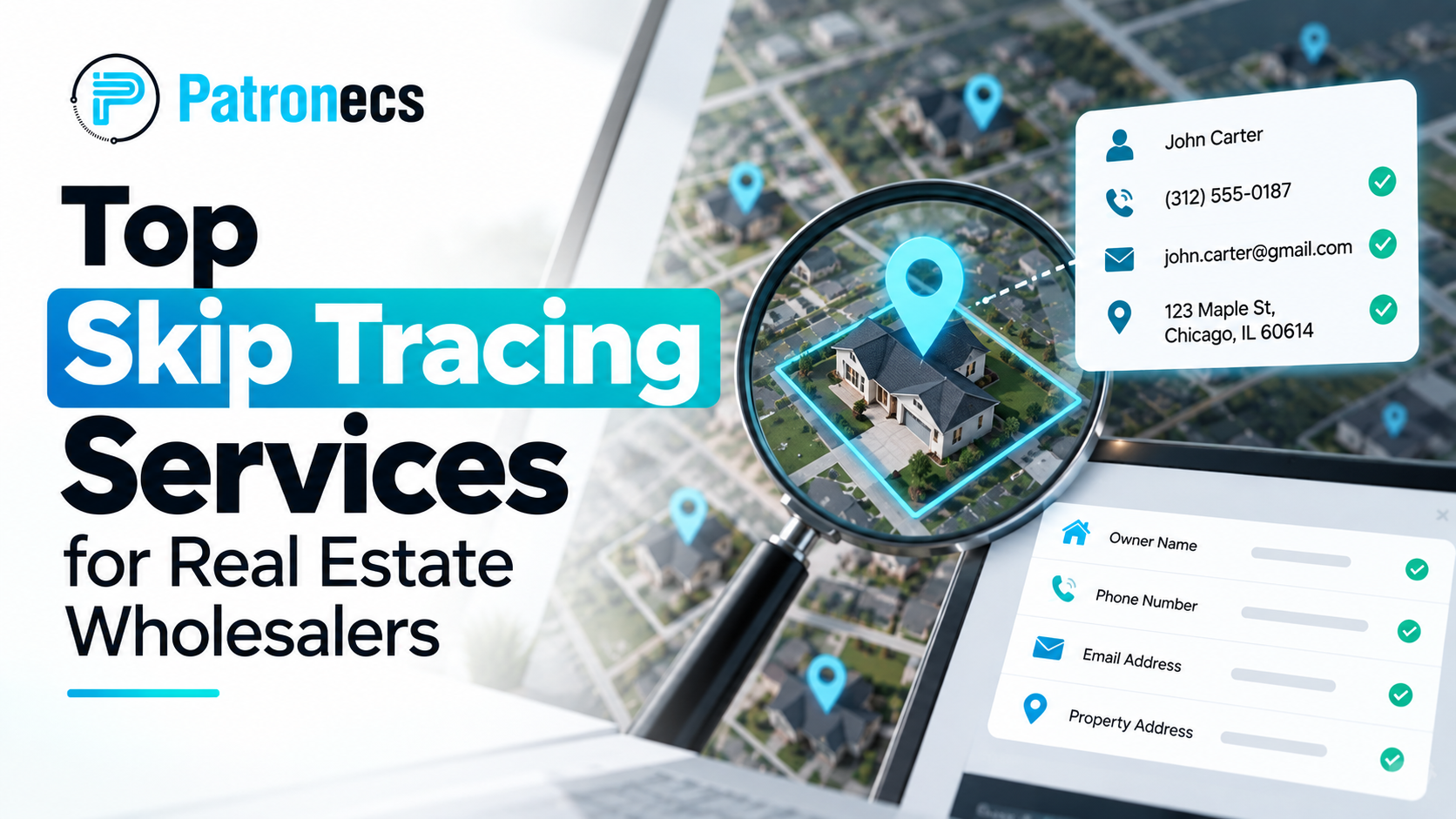
Finding a motivated seller is only useful if you can actually reach them.
For real estate wholesalers, skip tracing helps turn a property list into actionable contact information by helping identify phone numbers, email addresses, mailing addresses, and other owner-related data.
But choosing a skip tracing service isn't simply about finding the cheapest price per record.
Data freshness, match quality, bulk processing, LLC and trust ownership, compliance tools, integrations, and workflow automation can all affect how useful your skip-traced leads are.
In this guide, we'll look at some of the top skip tracing services for real estate wholesalers in 2026, what each platform is designed for, how skip tracing works, what it costs, and what you should consider before choosing a provider.
Important: Pricing, features, and data coverage can change. The prices and capabilities mentioned below are based on information available in 2026 and should be verified with each provider before purchasing.
Real estate skip tracing is the process of finding contact information associated with a property owner.
A wholesaler may start with a property address from a list such as:
The property data may identify the owner, but it may not provide a current phone number or email address.
Skip tracing attempts to enrich that record with additional contact information.
A typical workflow looks like this:
Property List → Owner Information → Skip Trace → Phone/Email Data → Contact Verification → Outreach → CRM → Follow-Up
For wholesalers, this can reduce the amount of time spent manually searching for property owners.
Wholesaling depends heavily on finding and contacting potential sellers.
Imagine a wholesaler has a list of 5,000 absentee-owner properties.
Without contact enrichment, the list might contain little more than:
Property Address + Owner Name
After skip tracing, the same records may include:
The exact information available varies by provider and record.
This makes skip tracing particularly useful for off-market lead generation and seller outreach. BatchData, for example, describes skip tracing as a way to identify contact information for absentee owners, vacant properties, and owners behind LLCs or trusts. (BatchData)
Modern skip tracing services typically combine information from multiple sources and use data matching to connect a property or owner record with potential contact information.
A simplified process looks like this:
The wholesaler uploads or creates a list of properties.
For example:
The records are submitted to a skip tracing platform.
Depending on the provider, this can happen through:
The service attempts to connect the property and ownership information with available identity and contact records.
Depending on the provider and record, results can include:
The wholesaler can then move the data into a:
This is where CRM integration becomes particularly important.
Before choosing a provider, don't focus only on the advertised price per record.
Consider these factors instead.
The most important question is:
Can you actually reach the person associated with the property?
A provider returning multiple phone numbers isn't necessarily better if most of those numbers are outdated or belong to someone else.
Contact information changes.
People change:
Older lead lists may therefore produce different results than recently updated records.
A phone hit rate generally refers to the percentage of submitted records for which the provider returns one or more phone numbers.
But be careful.
A returned phone number isn't necessarily a valid phone number for the correct person.
That's why it's useful to distinguish between:
Hit Rate → Does the system return a number?
and
Right-Party Contact → Does the number actually reach the correct person?
Recent industry material places real-estate owner-data hit rates in a broad range, with results varying significantly by list quality, geography, and data freshness. (BatchData)
This can be especially important for wholesalers.
A property may be owned by:
ABC Holdings LLC
instead of:
John Smith
If your skip tracing provider can help connect entity ownership with relevant individuals, you may have more useful information for your outreach workflow.
Not every provider handles LLCs, trusts, and corporate ownership in the same way.
If you're processing hundreds or thousands of leads, bulk upload capabilities can save considerable time.
Look for:
Skip tracing and real estate marketing involve more than finding contact information.
Depending on your outreach method and jurisdiction, you may need to consider:
Some platforms provide DNC or litigator screening as part of their workflows. PropStream, for example, says its skip-tracing workflow includes Do Not Call scrubbing, while its 2026 updates also added contact-priority and corporate skip-tracing capabilities. (PropStream)
Always verify applicable requirements for your specific marketing activity and jurisdiction.
This is one of the most overlooked factors.
Suppose your workflow looks like this:
PropStream → Export CSV → Skip Trace → Download CSV → Clean Data → Upload to CRM → Create Campaign → Assign Lead
That's a lot of manual work.
A more connected workflow looks like:
Lead List → Skip Trace → CRM → Automated Follow-Up
For wholesalers running thousands of leads, reducing unnecessary data transfers can save significant administrative time.
There isn't one provider that is objectively the right choice for every wholesaler.
Your best fit depends on:
Here are several platforms worth evaluating in 2026.
Best suited for: Investors who want property research, list building, and skip tracing in one platform.
PropStream is an established real estate data platform that combines property research and lead-generation tools with skip tracing.
Its 2026 skip-tracing updates introduced a redesigned workflow and expanded multi-source data capabilities. Users can skip trace properties directly from search results or property-detail workflows. (PropStream)
PropStream also announced corporate skip tracing, contact-priority ranking, and additional workflow improvements in late 2025. (PropStream)
PropStream's current plans and add-ons have changed during 2026. Its Connect offering bundles skip tracing with lead automation, click-to-dial, dialer campaigns, and other outreach tools. (PropStream)
If you're already using property-data tools to build your seller lists, having skip tracing within the same platform can reduce tool switching.
Best suited for: High-volume real estate data and skip-tracing workflows.
BatchData is designed around property data, identity resolution, skip tracing, and bulk processing.
The company says its platform combines real estate data with skip-tracing workflows and supports CRM integrations and large-scale processing. (BatchData)
It is also the current platform associated with the former BatchSkipTracing service; BatchData states that BatchSkipTracing was migrated to BatchData. (BatchData)
BatchData also publishes current cost benchmarks suggesting that real estate skip-tracing costs can vary substantially depending on volume and billing model. (BatchData)
High-volume acquisition teams can benefit from bulk workflows rather than processing properties individually.
Best suited for: Investors looking for a straightforward pay-per-match skip-tracing model.
REISkip offers skip tracing with property data, phone numbers, email addresses, and what it calls skip-trace triangulation.
Its published pricing currently lists $0.15 per match for its bulk and volume options, with minimum match requirements, while custom arrangements are available for larger needs. (Reiskip)
The straightforward pricing structure can make it easier for smaller teams to estimate their data-enrichment costs.
Best suited for: Wholesalers who want skip tracing integrated directly into a real estate CRM.
REsimpli takes a different approach from standalone skip-tracing services.
Instead of treating skip tracing as a separate data service, it places skip tracing inside an investor CRM workflow.
Its current plans include monthly skip-tracing allocations, with its published pricing page listing 10,000, 20,000, and 50,000 monthly credits across its primary plans. Additional skip tracing is listed at $0.15 per record. (REsimpli Help Center)
If your biggest problem is moving data between multiple platforms, an integrated CRM approach can simplify the workflow.
Best suited for: Investors looking for a dedicated skip-tracing option for property-owner research.
Skip Genie appears regularly in current 2026 comparisons of real estate skip-tracing tools alongside PropStream, BatchData, and other investor-focused platforms. (REsimpli)
Depending on the plan and workflow, investors can use skip-tracing tools to enrich property records with additional owner contact information.
When evaluating Skip Genie or any similar provider, compare your own sample results rather than relying solely on advertised hit rates.
Best suited for: Professional or investigative use cases requiring deeper identity research and where the user qualifies for access.
TLO-style data products are different from typical investor-oriented bulk skip-tracing platforms.
They can provide more extensive identity and investigative data, but access requirements, pricing, permitted uses, and appropriate users can be significantly different.
For a typical wholesaler simply looking to enrich a large motivated-seller list, a real-estate-specific provider may be operationally simpler.
There isn't a single answer for every real estate wholesaler.
Instead, match the provider to your workflow.
Consider platforms such as PropStream or BatchData.
Look closely at BatchData and other providers designed around bulk processing.
REISkip is one option to evaluate.
REsimpli is built around that workflow.
Professional data services such as TLO/TransUnion may be relevant, subject to access and permitted-use requirements.
The important point is that "best" depends on your actual workflow, volume, budget, and data requirements.
Skip tracing pricing can vary considerably.
Some providers charge:
Per record
Others charge:
Per successful match
And others bundle skip tracing into a:
Monthly subscription
Current 2026 market examples range from low-cost bulk matching to significantly higher-priced investigative searches. BatchData's current cost benchmarks, for example, show approximately $0.07–$0.25 per successful bulk hit and higher costs for manual or deep searches. (BatchData)
REISkip currently lists $0.15 per match for its published bulk and volume options. (Reiskip)
REsimpli currently bundles monthly skip-tracing allocations into its CRM plans and lists additional tracing at $0.15 per record. (REsimpli)
The cheapest price per record isn't necessarily the cheapest overall option.
Suppose Provider A charges:
$0.05 per record
And Provider B charges:
$0.15 per record
At first glance, Provider A looks cheaper.
But imagine:
1,000 records × $0.05 = $50
600 usable contacts =
$0.083 per usable contact
1,000 records × $0.15 = $150
800 usable contacts =
$0.1875 per usable contact
Provider A is still cheaper in this simplified example.
But if the difference in usable contacts is larger, the economics can change.
That's why wholesalers should track:
Total Skip Tracing Cost ÷ Usable Contacts
rather than looking only at the advertised record price.
Some high-volume investors test multiple providers against the same sample list.
For example:
500 records
↓
Provider A
↓
Provider B
↓
Provider C
Then compare:
This gives you a more meaningful comparison based on your own markets and lead types.
A provider can perform differently depending on geography and the type of list you're processing.
Skip tracing can be used with many different property lists.
Owners who don't appear to live at the property address.
Properties that may be unoccupied or underused.
Properties associated with unpaid property taxes.
Properties associated with estates and probate situations.
Properties associated with foreclosure-related records.
Owners with substantial estimated equity.
Potential landlords who may be considering selling rental properties.
Properties associated with municipal violations.
Owners who have attempted to sell without completing a transaction.
The appropriate use of these lists depends on local laws, data terms, and your marketing practices.
These are not the same thing.
Identifies which properties or owners you may want to target.
Example:
Find vacant homes owned by absentee owners with high equity.
Attempts to identify how you can contact those owners.
Example:
Find phone numbers and email addresses associated with those owners.
A typical wholesaling workflow therefore looks like:
Lead Generation → Skip Tracing → Contact → Qualification → Offer → Follow-Up
This is where the process becomes much more powerful.
Instead of keeping skip-traced contacts in a spreadsheet, investors can connect the information to their CRM.
A centralized workflow might look like:
Property List
↓
Owner Data
↓
Skip Trace
↓
Contact Information
↓
Lead Scoring
↓
CRM
↓
Call / SMS / Email
↓
Follow-Up
↓
Offer
↓
Contract
This allows investors to manage not just the contact information, but the entire acquisition process.
Every wholesaling operation has a slightly different process.
One team may focus heavily on:
Another may rely on:
A custom CRM can be designed around the workflow rather than forcing the business to adapt to a generic system.
For example, a custom wholesaling CRM could include:
New Lead → Contacted → Qualified → Offer Made → Negotiating → Under Contract → Closed
This brings the entire wholesaling process into one system.
Before committing to a provider, run a small test.
Use a representative sample from your actual lead lists.
Compare the results.
Track:
Don't stop at the price per record.
See how easily the results move into your existing workflow.
Check whether the provider offers the screening or suppression tools relevant to your outreach strategy.
The provider that fits your operation may not be the one with the lowest advertised price.
Low cost doesn't automatically mean low total cost.
Poor data can increase:
A high hit rate doesn't necessarily mean the number belongs to the correct person.
Test actual records from your market.
A phone number that was valid months ago may no longer be useful.
Remove:
before paying to enrich them.
A large number of investment properties may be owned through legal entities.
Your skip tracing strategy should account for entity ownership where appropriate.
Every export/import introduces another opportunity for:
Integrations can reduce this friction.
AI can help make skip-tracing workflows more useful, although it doesn't eliminate the need for reliable underlying data.
For example, AI can help:
Instead of simply receiving:
John Smith — 3 phone numbers — 2 emails
an AI-powered CRM could potentially organize the information into:
High-Priority Lead
Reason: Absentee owner + high equity + vacant property
Suggested Action: Call primary mobile number
Follow-Up: Send SMS if no answer
The AI isn't replacing the skip trace.
It's helping the investor do something useful with the data.
Skip tracing is an important part of the modern real estate wholesaling workflow because it helps turn property lists into actionable contact records.
But choosing a provider shouldn't be based solely on the cheapest price per record.
The better questions are:
How accurate is the data?
How fresh is it?
Can it handle my lead volume?
Does it resolve LLC ownership?
Does it support my CRM?
Does it fit my outreach workflow?
What does each usable contact actually cost?
Platforms such as PropStream, BatchData, REISkip, REsimpli, Skip Genie, and professional investigative data providers serve different use cases. The right choice depends on the size of your operation, the type of leads you're targeting, and how you manage outreach.
For wholesalers handling hundreds or thousands of leads, the bigger opportunity is connecting skip tracing with the rest of the acquisition process.
Lead generation → Skip tracing → Lead scoring → Outreach → Follow-up → Offer → Deal management
That's where a real estate CRM can become more valuable than a standalone contact database.
Skip tracing is only one part of a wholesaler's acquisition process.
If your team is constantly moving between property-data platforms, spreadsheets, skip-tracing services, dialers, email tools, and CRMs, it may be time to bring those workflows together.
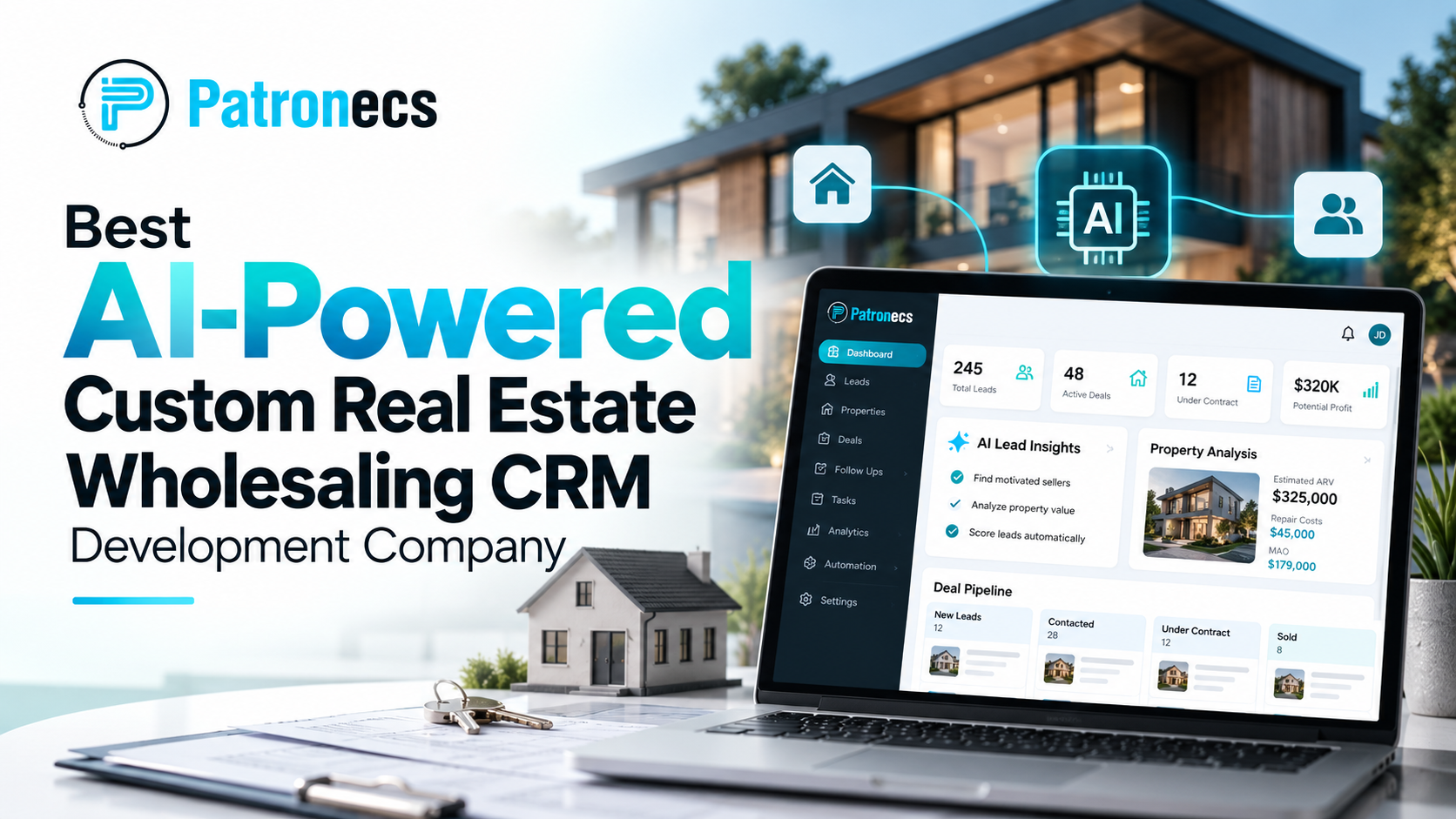
Patronecs helps businesses build custom CRM solutions for real estate wholesaling workflows, allowing teams to centralize property data, seller information, lead pipelines, follow-ups, deal analysis, and automation in one system.
A custom real estate CRM can be designed around your specific process rather than forcing your team to change how it works.
From AI-powered lead scoring and property analysis to automated follow-ups and deal pipelines, your CRM can become the central system connecting your acquisition workflow.
Want to build a custom real estate wholesaling CRM? Talk to Patronecs about designing a system around your team's workflow.
.png)
Discover the best AI tools for real estate wholesalers in 2026 to automate lead generation, follow-ups, marketing, and deal management.
.png)
Discover the signs your real estate business needs a CRM to improve communication, stop losing deals, and scale with confidence.
.png)
Discover the AI features every real estate wholesaling CRM must have to close more deals, automate workflows, and scale faster.
Skip tracing is the process of finding additional contact information associated with a property owner, such as phone numbers, email addresses, and mailing information.
Wholesalers use skip tracing to help identify contact information for property owners they may want to reach about potential off-market transactions.
Pricing varies by provider and model. Current 2026 examples range from low-cost bulk matching to higher-priced investigative searches. Some providers charge per record or match, while others bundle skip tracing into monthly subscriptions. (BatchData)
There isn't one universal benchmark that guarantees useful results. Published 2026 industry sources report broad ranges, but actual performance can vary by geography, lead type, data freshness, and provider methodology. Testing your own sample list is more useful than relying only on advertised percentages. (BatchData)
Yes. Depending on the provider and available records, skip tracing may return one or more phone numbers associated with a property owner.
Many real estate skip-tracing services provide email enrichment in addition to phone numbers, although coverage varies by provider and record.
Some platforms provide entity or corporate skip-tracing capabilities. PropStream, for example, introduced corporate skip tracing for company-owned properties in its updated platform. (PropStream)
The legality and permitted use of skip-traced data depend on the data source, jurisdiction, and how the information is used. Wholesalers should comply with applicable privacy, telemarketing, Do Not Call, SMS, consent, and other relevant requirements.
They serve different purposes. A skip tracing service enriches contact information, while a CRM manages leads, communication, follow-ups, deal stages, and other workflows. Some platforms combine both.
There is no universal schedule. The appropriate timing depends on how old the data is, the type of leads, campaign frequency, and your contact rate. Re-tracing can be useful when existing contact information becomes outdated.
There isn't one provider that is best for every wholesaler. PropStream, BatchData, REISkip, REsimpli, Skip Genie, and other providers have different approaches to data, pricing, integrations, and workflows. The best fit depends on your lead volume, data requirements, and acquisition process.

.svg)
.png)


