.avif)

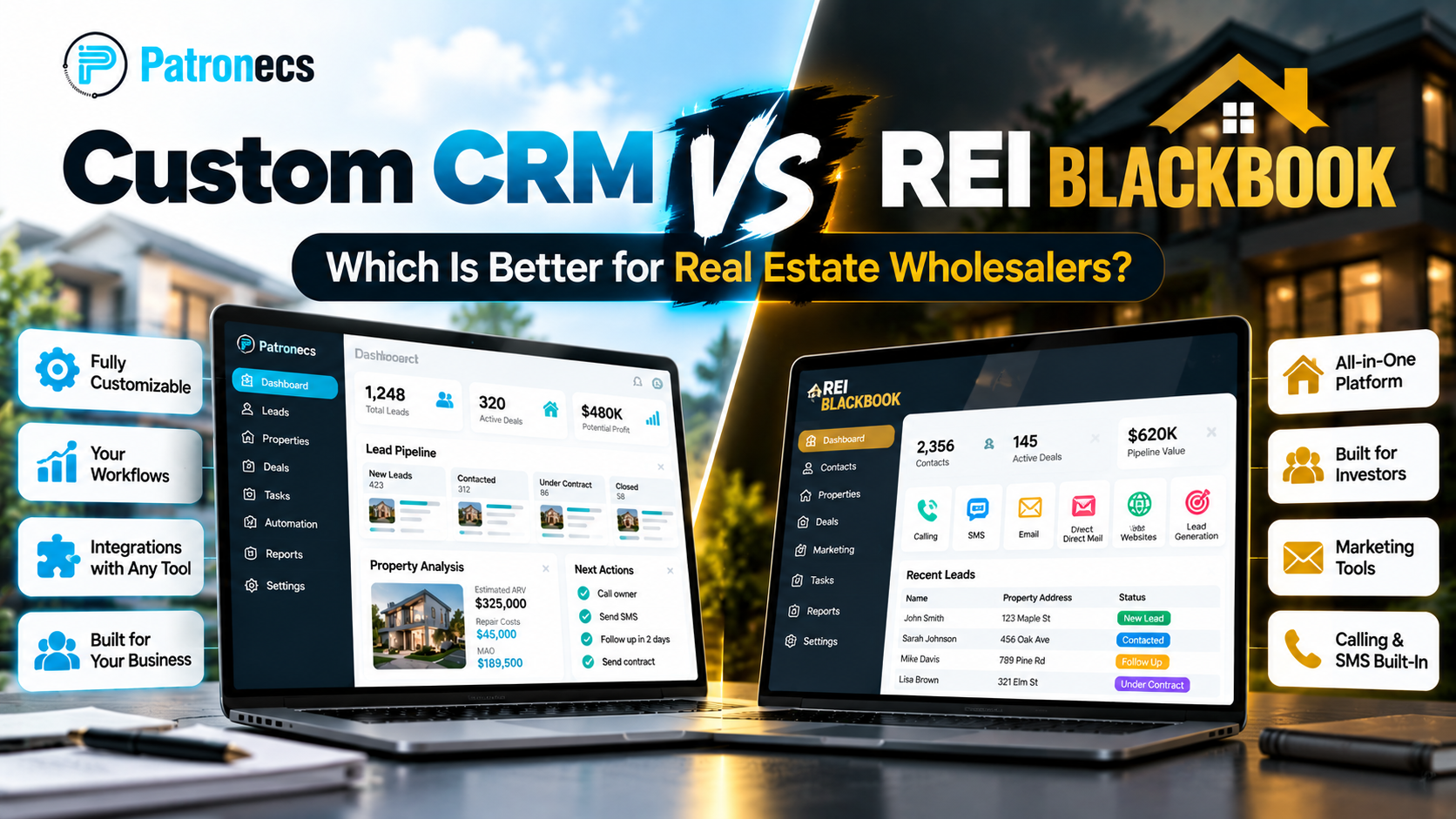
Real estate wholesalers don't just need a place to store contacts.
They need a system that can manage leads, track seller conversations, organize properties, automate follow-ups, coordinate acquisitions, manage buyers, and keep deals moving toward closing.
That's why choosing a CRM can become a major technology decision as a wholesaling business grows.
Two approaches often come up:
Use an established investor-focused platform like REI BlackBook.
Or:
Build a custom CRM around your own business processes.
REI BlackBook positions itself as an all-in-one operating system for real estate investors, combining CRM, lead capture websites, marketing automation, phone and texting, property pipeline management, direct mail, list generation, and other investor-focused tools. (REI BlackBook)
A custom CRM takes a different approach. Instead of adapting your operation to an existing platform, the software can be designed around your specific acquisition process, team structure, integrations, automation rules, reporting requirements, and growth plans.
So the real question isn't simply "Which CRM has more features?"
It's:
Which system fits the way your real estate business actually operates?
REI BlackBook is a real estate investor CRM and business automation platform designed to bring multiple investor workflows into one system.
Its current platform includes:
REI BlackBook's current pricing page lists three plans: Solo at $149/month, Team at $299/month, and Executive at $799/month when billed annually. The plans differ primarily by capacity, including users, active deals, websites, phone numbers, calling/SMS usage, and list pulls. (REI BlackBook)
The platform is therefore much more than a basic contact database.
It is designed to provide an existing operating environment for real estate investors.
A custom CRM is software designed specifically around a company's business processes.
Instead of asking:
"How can we change our workflow to fit this CRM?"
the business starts by asking:
"What should the CRM do for us?"
For a wholesaling company, that could include:
Capture leads from websites, PPC campaigns, cold calling, direct mail, referrals, and other sources.
Automatically classify leads according to motivation, property information, equity, communication history, or other criteria.
Manage seller conversations, appointments, property analysis, offers, and contracts.
Manage buyers, deal marketing, offers, buyer matching, and assignment processes.
Trigger tasks, notifications, messages, emails, and workflows automatically.
Track lead sources, acquisition performance, conversion rates, team activity, and deal profitability.
The system can be designed around the company's actual workflow instead of a predefined software structure.
REI BlackBook provides a dedicated CRM designed specifically for real estate investors.
Its CRM includes contact management, tagging and segmentation, custom fields, contact tabs, activity history, notes, property linking, document storage, and two-way text messaging. (REI BlackBook)
It can also automatically create contact records from inbound calls and website leads.
This creates a fairly complete environment for an investor who wants to centralize seller and buyer information.
A custom CRM can use a completely different data model.
For example, instead of simply having:
Contact → Property → Deal
you could structure your system as:
Lead → Seller → Property → Acquisition → Offer → Contract → Disposition → Buyer → Closing
Each relationship can have its own fields, statuses, permissions, automations, and reporting.
This becomes useful when your operation has more complex relationships between leads, properties, sellers, buyers, and deals.
Lead capture is a major component of REI BlackBook.
The platform includes lead-generating websites and landing pages designed to bring leads directly into its CRM. Its current plans include multiple lead-generating websites depending on the tier. (REI BlackBook)
REI BlackBook also describes automatic contact creation from website leads and inbound calls. (REI BlackBook)
For a wholesaler who wants to get an investor website and CRM working together without assembling several systems, this can simplify implementation.
A custom CRM can connect to whatever lead sources a business already uses.
For example:
Facebook Lead Ads
↓
Website Forms
↓
PPC Landing Pages
↓
Cold Calling
↓
Direct Mail
↓
Lead API
↓
Custom CRM
All incoming leads can then enter the same acquisition workflow.
The advantage isn't necessarily that a custom CRM generates more leads.
The advantage is that your existing lead sources can be organized around one system.
Follow-up is one of the core functions of REI BlackBook.
The platform includes follow-up automation, marketing automation, visual workflow functionality, email, phone, SMS, and other communication tools. (REI BlackBook)
For example, a lead could enter a predefined campaign after being captured.
A custom CRM can implement a similar concept but make the triggers specific to your business.
For example:
New seller lead
→ Assign acquisition manager
→ Send notification
→ Start qualification workflow
→ Attempt call
→ If no answer, send SMS
→ Schedule follow-up
→ If seller responds, stop automated sequence
→ Update lead score
→ Create appointment
→ Notify manager
The logic can be changed according to the company's actual process.
One interesting aspect of REI BlackBook is that it already offers substantial customization within the CRM.
Its CRM documentation specifically highlights unlimited custom fields and custom contact tabs. (REI BlackBook)
This means the difference between REI BlackBook and a custom CRM isn't simply:
custom fields vs no custom fields.
The bigger difference is customization of the underlying system itself.
For example, suppose your company uses a proprietary lead-scoring model.
You might want:
A custom system can calculate these values using your own rules.
It could then automatically determine:
Priority: High
Lead Score: 91
Next Action: Call Immediately
This type of business logic can be developed specifically around your acquisition strategy.
REI BlackBook includes a property pipeline designed to help investors manage deals.
Its property pipeline allows contacts such as sellers, buyers, lenders, and vendors to be connected to deals. The platform also includes rehab estimation functionality and document management. (REI BlackBook)
This makes it possible to move from:
Lead → Property → Deal
within the same environment.
A custom CRM can make the property pipeline much more specific.
For example:
New Lead
→ Qualified
→ Property Analyzed
→ Offer Prepared
→ Offer Sent
→ Negotiating
→ Under Contract
→ Inspection
→ Buyer Marketing
→ Buyer Selected
→ Assignment/Closing
Every stage could trigger specific tasks and automations.
For a business with a highly structured acquisitions and dispositions process, this level of workflow design can be important.
A real estate wholesaling CRM often needs to support two very different sides of the business.
The acquisition team focuses on:
The disposition team focuses on:
REI BlackBook provides buyer management and disposition functionality as part of its investor-focused platform. (REI BlackBook)
A custom CRM can create separate but connected workflows for both teams.
For example:
Acquisition closes a contract
↓
Deal automatically moves to Disposition
↓
Buyer list is filtered
↓
Matching buyers receive property information
↓
Offers are recorded
↓
Disposition manager receives tasks
↓
Closing status is tracked
This creates one connected workflow instead of separate acquisition and disposition systems.
Communication is another area where REI BlackBook is built as an integrated platform.
Its current plans include phone numbers, calling minutes, SMS, and a built-in phone and text system. (REI BlackBook)
Its phone system also supports inbound and outbound calling, call routing, call tracking, and two-way text messaging. (REI BlackBook)
For an investor who wants communication tools built into the CRM, this can reduce the need to connect several separate services.
A custom CRM can instead integrate the communication providers already used by the business.
For example:
CRM
→ Calling platform
→ SMS platform
→ Email provider
→ AI voice system
→ Call recording
→ Conversation transcription
This can be useful when a company has specific communication infrastructure or wants flexibility in choosing providers.
REI BlackBook currently advertises an Open API and integrations through Zapier and webhooks across its plans. (REI BlackBook)
That gives businesses options for connecting external systems.
However, there is a difference between:
Having an API
and:
Having a system designed around your integrations.
A custom CRM can be architected around the tools a business depends on.
For example:
Patronecs has experience building real estate CRM systems around integrations with lead sources, scheduling tools, calling platforms, SMS systems, and other real estate software. (Patronecs)
AI is becoming increasingly relevant to real estate CRM systems.
REI BlackBook's current plans include an AI Power Pack as an add-on on its Solo and Team tiers and included with its Executive tier. Its current pricing page also lists a ListHQ AI Suite focused on seller intelligence and motivation signals. (REI BlackBook)
That gives investors a way to add AI capabilities without building them from scratch.
A custom CRM takes a more tailored approach.
Instead of adding AI as a standalone feature, you can connect AI directly to business workflows.
For example:
Analyze incoming lead information and categorize it.
Identify which leads should receive immediate attention.
Turn conversations into structured CRM records.
Generate personalized seller follow-ups.
Assist with property and offer analysis.
Match properties with relevant buyers.
Summarize acquisition and disposition performance.
Patronecs' current CRM content similarly focuses on AI-powered lead scoring, automated follow-ups, AI assistants, centralized communication, workflow automation, and AI reporting. (Patronecs)
REI BlackBook includes reporting and CRM activity features within its platform. (REI BlackBook)
But businesses often need reports that are specific to their internal KPIs.
A custom CRM could provide dashboards such as:
The key difference is that the dashboard can be designed around your definition of success.
REI BlackBook includes team management and permissions on its higher plans.
Its current Team plan supports up to five users, while the Executive plan supports up to 15 users. The platform also includes team activity visibility, lead assignment workflows, and role permissions on those plans. (REI BlackBook)
For many small and medium-sized operations, this may be sufficient.
A custom CRM can take a more granular approach.
For example:
Can create leads but cannot modify offers.
Can manage sellers, appointments, offers, and contracts.
Can access contracted properties and buyer records.
Can view team activity and performance.
Controls the entire system.
These permissions can be designed around your organization's hierarchy.
REI BlackBook's current pricing is publicly listed as:
PlanCurrent Listed Price*UsersActive DealsSolo$149/month125Team$299/monthUp to 5100Executive$799/monthUp to 15Unlimited
*The current pricing page lists these prices when billed annually. Additional usage and add-ons may apply. (REI BlackBook)
The platform also lists additional costs for items such as users, phone numbers, storage, SMS, and calling beyond included allowances. (REI BlackBook)
A custom CRM has a different cost structure.
Typically:
Development
Integrations
Hosting/infrastructure
Maintenance
Future improvements
The initial investment can therefore be substantially higher than subscribing to a SaaS CRM.
But the comparison shouldn't stop at monthly pricing.
You should also consider:
The more unique your requirements become, the more important total cost of ownership becomes.
This is an important distinction.
With REI BlackBook, the core software already exists.
You can create an account, configure your settings, import or capture leads, and start using the platform.
The company currently advertises a 14-day trial and a fast-track onboarding process. (REI BlackBook)
A custom CRM requires a development process.
That typically involves:
Patronecs describes a similar structured process for its custom CRM/Podio development work. (Patronecs)
So if speed to implementation is the main requirement, an existing platform has a natural advantage.
REI BlackBook scales through its available plans and platform capabilities.
The current Executive plan, for example, supports unlimited active deals and up to 15 users, along with higher communication and list-generation allowances. (REI BlackBook)
But software scalability and business scalability aren't always the same thing.
A business may eventually require:
At that point, the question becomes:
Can the existing CRM accommodate the business model?
A custom CRM allows the architecture to evolve alongside the business.
With an existing SaaS platform, your business operates within the provider's technology environment.
That means the provider controls the core platform architecture, feature roadmap, and software environment.
A custom CRM gives the business greater control over how the system is structured and extended.
That can include:
Patronecs specifically highlights customization, scalability, integration, and ownership/control as benefits of custom Podio development. (Patronecs)
This doesn't mean every company needs a fully custom system.
It means control becomes increasingly relevant when your CRM itself becomes an important part of your operating model.
REI BlackBook can be a practical option for businesses looking for an established real estate investor platform with many capabilities already connected.
It may make sense when you want:
Instead of designing your technology stack from the ground up, you start with an existing platform.
Custom CRM development becomes more relevant when the business has requirements that go beyond configuration.
Consider a custom CRM when you need:
Your lead qualification and offer process is different from standard investor workflows.
Your operation depends on multiple external systems that need to exchange data.
You have your own criteria for determining which sellers should receive priority.
You want business events to automatically trigger specific actions.
Your management team requires metrics that aren't available in standard reports.
Acquisitions, dispositions, marketing, transaction coordination, and management need different workflows.
You want AI embedded into your own operating processes.
You want dedicated seller, buyer, or partner portals connected to your CRM.
You want your software architecture to evolve with the business.
You don't necessarily have to abandon REI BlackBook to introduce custom technology.
A business can potentially keep its existing platform and add integrations or supporting systems where appropriate.
For example:
REI BlackBook
↓
Integration Layer
↓
Custom Automation
↓
AI
↓
Reporting
This approach can make sense when the existing platform already handles the core workflows but the business needs additional functionality.
The exact feasibility depends on the platform's available APIs, integrations, data access, and the specific workflow being built.
Instead of choosing based only on feature count, evaluate these areas.
Is your process relatively standard or highly customized?
Are you operating alone, or do you have separate acquisition, disposition, marketing, and operations teams?
How many external platforms does your business rely on?
How much repetitive work can realistically be automated?
Do you need a specialized database structure?
Do you need AI as a general productivity tool or as part of your proprietary workflow?
Can the existing CRM provide the KPIs your management team actually needs?
Do you need to launch immediately, or can you invest time in development?
Are you optimizing for low initial software costs or long-term control?
Will your business processes remain relatively stable, or are you expecting major operational changes?
At Patronecs, the approach to real estate CRM development starts with the business workflow rather than a predefined software package.
Patronecs' current real estate CRM offering is built around a Podio-based system with acquisition and disposition management, notifications, AI-based drip campaigns, integrations, and custom workflows. Its custom tier is specifically positioned for businesses that need a tailored CRM solution. (Patronecs)
That distinction matters.
A custom CRM doesn't need to compete with REI BlackBook feature-for-feature.
The goal is different.
Instead of asking:
"How can we use all these features?"
the business can ask:
"Which processes are costing us time, and how should our CRM handle them?"
For example, a wholesaling company might need a system where:
Lead enters
↓
AI evaluates lead
↓
Lead assigned to acquisition manager
↓
Call automatically logged
↓
Seller receives follow-up
↓
Property analysis created
↓
Offer generated
↓
Contract status updated
↓
Deal moves to disposition
↓
Buyer list filtered
↓
Marketing launched
↓
Closing tracked
That entire process can become the architecture of the CRM.
Patronecs' custom CRM work also emphasizes requirement gathering, solution design, integrations, testing, deployment, training, and ongoing support. (Patronecs)
REI BlackBook and a custom CRM represent two different approaches to real estate technology.
REI BlackBook provides an established investor-focused ecosystem with CRM, lead capture, marketing automation, phone and SMS, property pipelines, direct mail, list generation, deal management, and other tools in one platform. (REI BlackBook)
A custom CRM gives a business the opportunity to design its own workflows, integrations, business logic, dashboards, permissions, and automation.
Neither approach needs to be treated as universally applicable.
For an investor who wants a ready-to-use system with built-in real estate functionality, an established platform can simplify implementation.
For a wholesaling operation with specialized workflows, complex integrations, proprietary processes, or a need for deeper control, custom development can provide a different level of flexibility.
And there is a third option:
Keep the software that already works and customize the parts that don't.
The best CRM architecture is ultimately the one that fits the way your team actually generates leads, communicates with sellers, manages properties, closes deals, and grows.
Your CRM shouldn't become another process your team has to work around.
It should support the way your business already operates—and make that process easier to manage, automate, and scale.
Patronecs builds and customizes real estate CRM systems around acquisition, disposition, automation, integrations, and business-specific workflows. (Patronecs)
Explore Patronecs' Real Estate CRM solutions for a system built around your business requirements rather than a fixed workflow. Patronecs Real Estate CR

Learn how to calculate ARV (After Repair Value) using the proven formula, comparable sales, and repair costs. A complete guide for wholesalers, house flippers, and real estate investors.
.png)
Looking for the best AI-powered real estate wholesaling CRM development company? Learn what to look for and why custom CRM solutions outperform generic software.
Yes. REI BlackBook provides a real estate investor CRM alongside lead capture, marketing automation, communication, property pipeline, and other investor-focused functionality. (REI BlackBook)
REI BlackBook's current pricing page lists Solo at $149/month, Team at $299/month, and Executive at $799/month when billed annually. Usage limits and add-ons vary by plan. (REI BlackBook)
REI BlackBook is specifically positioned for real estate investors and includes workflows relevant to wholesaling, including lead management, follow-up, property pipelines, buyer management, marketing, communication, and deal management. (REI BlackBook)
Yes. REI BlackBook supports features such as custom fields, contact tabs, tagging, segmentation, workflows, and other configuration options. However, customization within an existing SaaS platform is different from developing the underlying CRM architecture yourself. (REI BlackBook)
Potentially. The exact possibilities depend on REI BlackBook's available API, integrations, webhooks, and the specific data or workflow you want to connect. Its current plans advertise an Open API, Zapier, and webhooks. (REI BlackBook)
The initial investment is generally higher because custom software requires design, development, integrations, testing, deployment, and maintenance. The comparison should therefore consider long-term operational costs rather than subscription price alone.
Yes. AI can be integrated into lead scoring, qualification, communication, call summaries, follow-up, reporting, property analysis, and buyer matching.
That depends on whether the current platform is meeting your business requirements. If your existing workflows work well, switching may not be necessary. If you're repeatedly working around software limitations or relying on multiple disconnected systems, custom development may be worth evaluating.
.webp)
.svg)
.png)


