.avif)

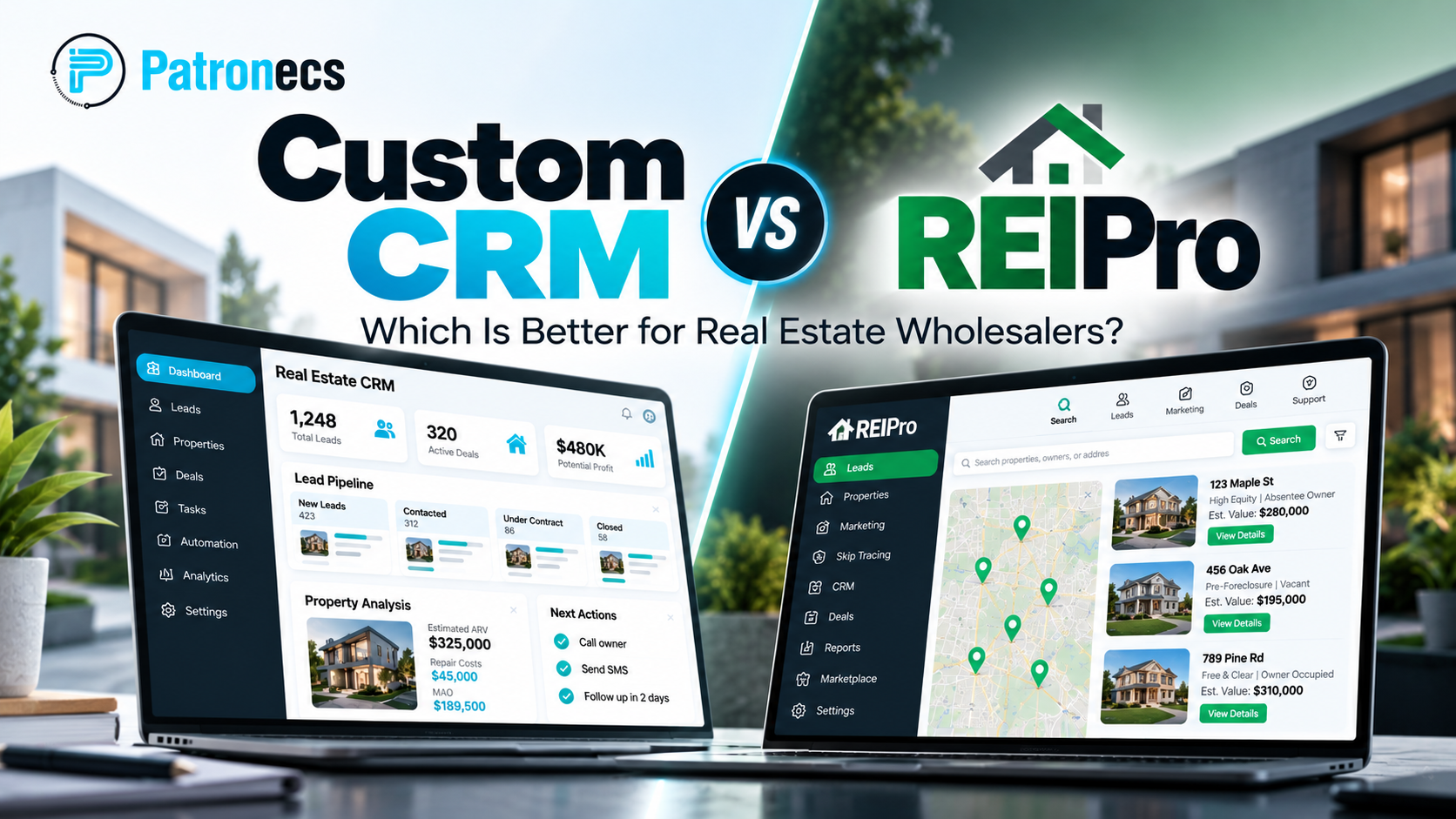
Choosing a CRM is one of the more important technology decisions a real estate wholesaling business can make.
A CRM can determine how your team captures leads, follows up with sellers, manages properties, analyzes deals, communicates with buyers, and moves opportunities through your pipeline.
For investors looking for an out-of-the-box solution, REIPro provides a real estate-focused platform with lead data, property research, deal analysis, CRM functionality, direct mail, skip tracing, and guided workflows. Its current pricing page lists a Standard plan at $109/month and a Team plan at $297/month, with a 14-day trial. (REIPro)
But there is another approach:
Build a custom CRM around the way your business actually operates.
Instead of adapting your processes to predefined software, a custom CRM can be designed around your acquisition process, disposition workflow, team structure, integrations, automation requirements, reporting, and future growth.
So, which approach makes more sense?
The answer depends less on the number of features and more on how unique and complex your business processes are.
REIPro is real estate investing software designed specifically for investors.
Its platform combines property research, lead generation, CRM functionality, deal analysis, marketing, direct mail, skip tracing, and educational resources.
According to REIPro's current product information, the platform provides access to more than 156 million property records, nationwide lead sources, property analytics, MLS comps, a 10-step workflow, a rehab calculator, deal analysis, buyer/contact management, direct mail tools, and skip tracing. (REIPro)
Its lead-generation system supports filters for criteria such as:
REIPro also provides list stacking and allows users to save and export leads. (REIPro)
This makes REIPro particularly relevant to investors who want a ready-made real estate investing system rather than building their technology stack from the ground up.
A custom CRM is a customer relationship management system designed specifically around a company's workflows and requirements.
Instead of starting with:
"What does this CRM allow us to do?"
you start with:
"What does our business need the system to do?"
For a real estate wholesaler, that could mean creating workflows for:
The CRM can then be built around those requirements.
This is the fundamental difference between using a software product and building a business system.
One of REIPro's major advantages is that lead generation is already part of the platform.
REIPro states that its system provides access to more than 156 million property records and multiple nationwide lead sources. Users can filter properties by factors such as equity, ownership, property characteristics, foreclosure status, and other criteria. (REIPro)
This means an investor can start researching potential opportunities without first assembling a separate property-data infrastructure.
A custom CRM takes a different approach.
Instead of necessarily providing the property data itself, it can connect to the data providers your business already uses.
For example:
Property Data → Lead Source → Custom CRM → Lead Scoring → Acquisition Team → Follow-Up
This can be useful when a wholesaler already has preferred data providers and wants the CRM to act as the central operating system.
REIPro includes buyer and contact management alongside its property and investing workflows. Its platform is designed to take an investor from lead research through deal management using a structured workflow. (REIPro)
That's useful for investors who want a predefined process.
A custom CRM can go further by defining exactly what happens to a lead inside your organization.
For example:
↓
↓
↓
↓
↓
↓
↓
↓
↓
↓
↓
Every stage can have its own rules, permissions, notifications, tasks, and automations.
This is one of the biggest differences between the two approaches.
REIPro provides a structured 10-step workflow and tracker designed to guide investors through the deal process. (REIPro)
For someone who wants an established process, this can reduce the amount of system design required.
A custom CRM doesn't have to follow a predefined workflow.
You could create different processes for different lead sources.
For example:
PPC Lead
→ Instant notification
→ AI qualification
→ Acquisition manager assignment
→ Call within 5 minutes
→ Follow-up sequence
Whereas:
Cold Call Lead
→ Call disposition
→ Seller motivation score
→ Automated SMS
→ Follow-up task
→ Re-engagement campaign
The system can be designed around your actual operating model.
This is where custom CRM development becomes particularly relevant.
Imagine your company has a rule:
If a property has more than 40% equity, is absentee-owned, has been held for more than 10 years, and the owner has responded to at least one campaign, increase its lead priority.
A custom CRM can be designed to implement that logic.
You could then display:
Lead Score: 87/100
Priority: High
Recommended Action: Call Today
The exact rules could be changed as your acquisition strategy evolves.
With packaged software, you're generally working within the capabilities and configuration options provided by the vendor.
REIPro includes skip tracing functionality and its current pricing information lists skip tracing credits as part of its plans, with additional skip tracing available as an in-app purchase. (REIPro)
This can be useful because the process stays connected to your lead-generation workflow.
A custom CRM can instead connect to the skip-tracing provider your business prefers.
For example:
Lead List
→ CRM
→ Skip Trace API
→ Phone + Email Data
→ DNC Filtering
→ Lead Scoring
→ Campaign
This approach is particularly useful if your organization already has preferred data providers or wants to switch providers later.
REIPro has a strong focus on investor marketing.
Its marketing tools include postcards, letters, flyers, email materials, and direct-mail campaigns. REIPro also provides campaign creation and skip-tracing capabilities within its ecosystem. (REIPro)
For an investor who wants these capabilities available immediately, this reduces setup work.
With a custom CRM, marketing doesn't necessarily need to be built from scratch.
Instead, the CRM can connect to external platforms.
For example:
CRM
→ SMS platform
→ Email platform
→ Direct mail provider
→ Calling platform
→ Marketing automation
This creates a modular technology stack.
Integrations can become increasingly important as a wholesaling business grows.
A typical real estate operation may use:
A custom CRM can be designed to connect these systems around one central database.
Patronecs, for example, has developed real estate CRM systems with integrations involving lead sources, websites, scheduling platforms, calling tools, SMS platforms, marketing systems, and other real estate technology. (Patronecs)
The objective isn't simply to have more integrations.
It's to make information move automatically between systems.
REIPro provides property analytics and investor-oriented tools within its platform. (REIPro)
A custom CRM allows you to decide exactly which metrics your management team needs.
For example:
This can turn the CRM into an operational dashboard rather than simply a place to store contacts.
AI is becoming increasingly relevant to real estate operations.
A custom CRM can incorporate AI into specific business processes rather than simply adding a chatbot.
For example:
Automatically analyze incoming seller information and classify leads.
Prioritize leads based on predefined signals.
Generate context-aware SMS or email responses.
Convert calls into structured CRM notes.
Assist with ARV, repairs, and offer calculations.
Match properties with buyers based on criteria.
Summarize pipeline performance and identify follow-up gaps.
Patronecs has also been developing AI implementation workflows around CRM automation, AI calls and messaging, document processing, and internal dashboards. (Patronecs)
The important distinction is that AI can be designed around the workflow, rather than being treated as an isolated feature.
REIPro's Team plan supports up to 12 users and includes features such as team administration, isolated team members, lead sharing, calendar sharing, chat, and individual customizations. (REIPro)
For a small team, this may cover the basic organizational requirements.
A custom CRM can define more granular rules.
For example:
Lead Generator
Can create and update leads.
Acquisition Manager
Can access seller information and offers.
Disposition Manager
Can access contracted properties and buyers.
Manager
Can access all dashboards and reports.
Admin
Can manage system settings.
These permissions can be designed around your organizational structure.
Pricing is one area where the comparison needs some context.
REIPro's current pricing page lists:
The Standard plan supports up to three users, while the Team plan supports up to 12 users. The plans also include different export and skip-tracing allocations. (REIPro)
A custom CRM works differently.
There is usually:
Initial development cost
Integrations
Hosting/software costs
Maintenance and support
Future development
So a custom CRM generally requires a larger initial investment than subscribing to an existing platform.
But comparing only the monthly subscription isn't enough.
You should also consider:
The right comparison is total cost of ownership, not simply monthly subscription price.
REIPro is designed to support real estate investors as they manage leads, properties, marketing, and deals.
Its Team plan provides additional team-management capabilities and higher export/skip-tracing allowances. (REIPro)
However, there is an important distinction between scaling within a software platform and scaling the software around your business.
A custom CRM can evolve when your processes change.
For example, you may eventually need:
A custom system can be extended as those requirements appear.
This is another consideration that businesses often overlook.
With a SaaS CRM, your business operates within the provider's software environment, architecture, feature roadmap, and policies.
With a custom CRM, the business has greater control over:
Patronecs specifically highlights ownership and control as benefits of custom Podio development, alongside customization, scalability, centralized data, and integrations. (Patronecs)
That doesn't automatically make custom development the right choice for every investor.
It simply changes the relationship between the business and its software.
REIPro can make sense when you want an existing real estate investing platform with many core tools already connected.
It may be suitable when you need:
Instead of spending months designing a system, you can start with an established workflow.
A custom CRM becomes more relevant when your business doesn't fit neatly into a standard workflow.
Consider custom development when you need:
Your acquisition process is different from the standard investor workflow.
You rely on several external tools that need to communicate with each other.
You want specific business events to automatically trigger actions.
Your management team needs metrics that aren't available in standard dashboards.
You want AI integrated directly into lead qualification, communication, analysis, or operations.
Your business has separate acquisition, disposition, marketing, and operations teams.
Your workflow itself is part of your competitive advantage.
You don't want every new requirement to depend on whether a SaaS vendor adds a feature.
You don't necessarily have to choose between REIPro and custom development immediately.
There is a third option:
For example:
REIPro
→ Custom integration
→ CRM/Operations System
→ AI automation
→ Communication tools
→ Reporting
This can allow a business to keep the parts of REIPro that are useful while adding custom functionality around them.
The same principle applies to businesses already using other CRMs.
At Patronecs, the approach is often to work with the tools a business already uses rather than automatically forcing a complete replacement. Patronecs describes its implementation work around existing CRMs, Podio, GoHighLevel, automation platforms, integrations, and custom applications. (Patronecs)
Instead of asking:
"Which CRM is better?"
ask these questions:
If your workflow is straightforward, an existing platform may be sufficient.
If you're constantly moving information between platforms, integration may become more important.
The more repetitive work your team performs, the more valuable automation can become.
If your acquisition or disposition process relies on unique rules, customization becomes more relevant.
An existing CRM can generally be implemented faster than a custom system.
Your technology decision shouldn't only solve today's problem.
At Patronecs, the goal isn't simply to replace one CRM with another.
The focus is on understanding how the real estate business operates and then designing technology around those processes.
Patronecs offers Podio-based CRM development, custom low-code applications, integrations, workflow automation, real estate websites, and AI-powered automation.
Its real estate CRM work includes capabilities such as lead management, buyer management, campaigns, task assignment, appointments, drip sequences, offer management, team management, and integrations with external tools. (Patronecs)
That means the conversation can start with:
"What does your business need?"
rather than:
"Which features does the software already have?"
For businesses that already have a CRM, Patronecs can also focus on customization, integrations, automation, and AI implementation instead of requiring an immediate migration. (Patronecs)
REIPro and a custom CRM solve different problems.
REIPro provides a ready-made real estate investing environment with property data, lead generation, deal analysis, CRM functionality, direct mail, skip tracing, and structured workflows. (REIPro)
A custom CRM takes the opposite approach: the software is designed around your business processes, integrations, team structure, automation requirements, and future requirements.
For a wholesaler who wants to start quickly with an established real estate system, REIPro provides a substantial set of built-in capabilities.
For a growing operation with unique workflows, multiple systems, complex automation, or proprietary processes, custom CRM development can provide a different level of control and flexibility.
And there is a middle ground: keep the tools that already work and build the missing layer around them.
That's often where custom CRM development becomes less about replacing software and more about building the operating system your business actually needs.

Learn how to calculate ARV (After Repair Value) using the proven formula, comparable sales, and repair costs. A complete guide for wholesalers, house flippers, and real estate investors.
.png)
Looking for the best AI-powered real estate wholesaling CRM development company? Learn what to look for and why custom CRM solutions outperform generic software.
Yes. REIPro includes CRM functionality alongside property research, lead generation, deal analysis, marketing, direct mail, skip tracing, and other real estate investing tools. (REIPro)
REIPro's current pricing page lists a Standard plan at $109/month and a Team plan at $297/month. The Standard plan supports three users, while the Team plan supports 12 users. Pricing and included features can change, so businesses should verify the current pricing before subscribing. (REIPro)
REIPro is designed for real estate investors and includes tools relevant to wholesaling, including lead generation, deal analysis, property research, CRM functionality, marketing, and direct mail. (REIPro)
Usually, custom CRM development requires a larger initial investment because the system has to be designed, developed, integrated, tested, and maintained. However, the appropriate comparison should consider total cost of ownership and the number of tools and manual processes the CRM replaces.
Yes. A custom CRM can be connected to external skip-tracing services when an appropriate API or integration is available.
Yes. AI can be incorporated into processes such as lead qualification, seller scoring, call summaries, follow-up, document processing, reporting, and other workflows.
Potentially, yes. The exact approach depends on available integrations and APIs. A custom system can sometimes be built around an existing platform rather than requiring an immediate replacement.
The decision depends on your workflow, team size, required integrations, automation needs, budget, implementation timeline, and how much customization your operation requires. There isn't a single CRM architecture that fits every wholesaling business.
If your team has outgrown spreadsheets—or you're spending too much time moving data between different tools—the next step may not be another off-the-shelf CRM.
It may be a system designed around how your business actually works.
Patronecs helps real estate businesses build and customize CRM systems, automate workflows, connect third-party tools, and implement AI-powered processes. (Patronecs)
Build less around the software. Build the software around your business.
Explore Patronecs Real Estate CRM Solutions
.webp)
.svg)
.png)


