.avif)

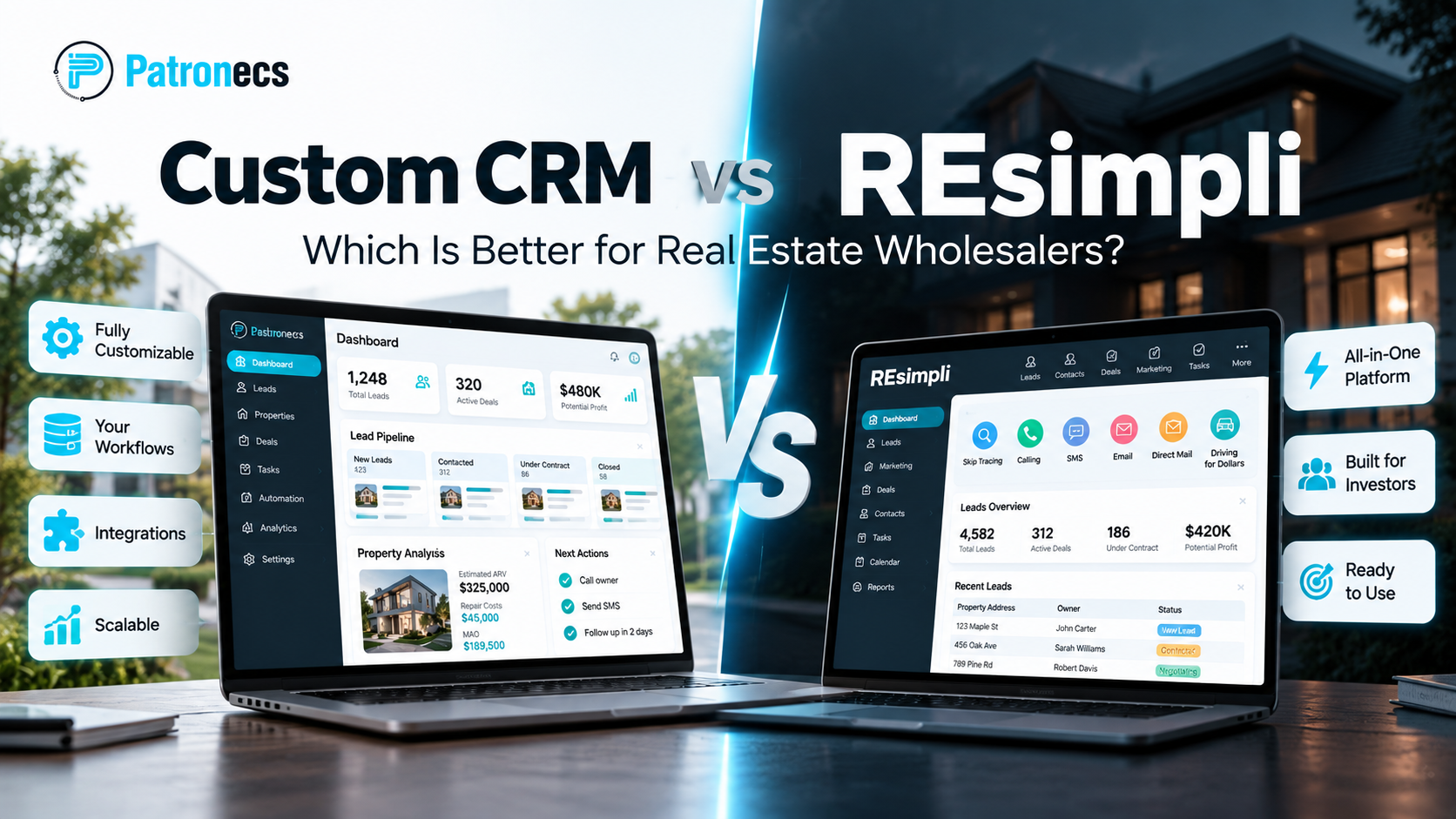
Choosing a CRM is one of the most important technology decisions a real estate wholesaling business can make.
Your CRM sits at the center of your acquisition process. It can determine how quickly your team responds to sellers, how leads move through your pipeline, how follow-ups are handled, how deals are analyzed, and how much of your operation can be automated.
For many wholesalers, REsimpli is an attractive option because it provides an all-in-one platform specifically designed for real estate investors. It combines CRM functionality with list building, skip tracing, calling, SMS, email, direct mail, list stacking, Driving for Dollars, automation, and other investor-focused tools. (REsimpli)
But there is another approach:
Build or customize a CRM around your own business.
A custom real estate CRM can be designed around your acquisition process, existing tools, team structure, reporting requirements, integrations, and automation logic rather than asking your business to work within a predefined software model.
So which approach makes more sense?
The answer depends on what you're trying to accomplish.
This guide compares Custom CRM vs. REsimpli across features, customization, automation, integrations, scalability, cost, implementation, and long-term flexibility.
Neither approach is automatically right for every wholesaler.
The real question is:
Do you want software that already has a wholesaling workflow built into it, or do you want a system built around the way your business actually operates?
REsimpli is an all-in-one CRM platform designed specifically for real estate investors.
Its current platform combines CRM and lead management with tools such as:
REsimpli describes its platform as a system that combines data, marketing, sales, and operations for real estate investors. (REsimpli)
Its CRM functionality includes customizable lead statuses, advanced filtering, wholesale pipelines, communication tools, dashboards, and performance tracking. (REsimpli)
That makes REsimpli substantially different from a generic CRM such as a standard sales CRM.
It was built around the requirements of real estate investors.
A custom CRM is software designed and configured specifically around your business processes.
Instead of starting with:
"What features does this CRM provide?"
you start with:
"What does our business need the CRM to do?"
For a real estate wholesaler, a custom CRM might include:
And because it is custom, the system can be connected to the tools your business already uses.
Lead management is at the heart of any wholesaling CRM.
REsimpli provides a centralized lead pipeline with customizable statuses, filtering, communication tools, and wholesale deal management. (REsimpli)
For a wholesaler following a relatively standard acquisition process, this can be enough.
A custom CRM takes a different approach.
You can define exactly how a lead should move through your business.
For example:
New Lead
↓
Skip Traced
↓
Contact Attempted
↓
Seller Responded
↓
Qualified
↓
Property Analyzed
↓
Offer Sent
↓
Negotiating
↓
Under Contract
↓
Dispositions
↓
Closed
You can also create different pipelines for different lead sources.
For example:
PPC Leads
Cold Call Leads
Direct Mail Leads
Driving for Dollars
Probate
Tax Delinquent
Referral Leads
This is where custom development becomes useful for businesses with complex acquisition processes.
REsimpli has skip tracing integrated directly into its platform.
Its current skip-tracing feature advertises phone and email enrichment, DNC scrubbing, and LLC/trust searches. (REsimpli)
The current plans include monthly skip-tracing allocations, with published limits of 10,000, 20,000, and 50,000 credits depending on plan. (REsimpli)
This can be convenient because users don't necessarily need a separate skip-tracing platform.
A custom CRM doesn't automatically provide skip tracing.
Instead, it can integrate with the provider your business prefers.
For example:
Property Data → Custom CRM → Skip Tracing API → Contact Data → CRM → Outreach
This provides more control over the data provider.
That can matter if your team already has preferred data sources or needs specialized data workflows.
REsimpli provides automated workflows and multi-channel campaigns.
Its platform supports automated outreach using channels including SMS, email, ringless voicemail, tasks, and direct mail. (REsimpli)
For example:
New Lead
→ Send SMS
→ Wait 2 days
→ Send Email
→ Create Call Task
→ Send RVM
→ Follow Up
This works well when your workflow fits the platform's automation capabilities.
With a custom CRM, the automation logic can be designed around your exact requirements.
For example:
If a lead is tagged "Absentee + High Equity + Vacant," skip trace automatically, score the lead, assign it to Acquisitions Manager A, create a call task, and enroll it in the appropriate follow-up sequence.
Or:
If a seller responds positively to an SMS, stop the automated campaign, notify the acquisitions manager, update the lead status, and create a priority task.
Custom automation can go much deeper because the rules are designed specifically for your business.
AI is becoming increasingly important in real estate wholesaling.
REsimpli currently offers AI-related capabilities including AI lead-management and AI Copilot features, with its pricing materials listing agents for functions such as inbound sales coordination, speed-to-lead, SMS conversation assistance, lead scoring, deal intelligence, contact intelligence, call review, and seller appointment coaching. (REsimpli)
That's a significant advantage for teams looking for AI capabilities without building them from scratch.
A custom CRM can take a different approach.
Instead of using a predefined AI workflow, you can determine where AI should actually operate within your business.
For example:
Analyze:
Automatically extract:
Assist with:
Match a deal against buyers based on:
The important distinction is prebuilt AI vs. business-specific AI.
REsimpli provides an open API, and its current plans advertise API access without usage fees. (REsimpli)
That provides opportunities for businesses that need to connect REsimpli with other systems.
However, your integration strategy still depends on what the platform supports and how your workflows are structured.
With a custom CRM, integrations can be treated as part of the architecture from the beginning.
For example:
Lead Source
↓
Custom CRM
↓
Skip Tracing
↓
AI Lead Scoring
↓
Dialer
↓
SMS
↓
ARV Calculator
↓
Document Generation
↓
E-Signature
↓
Accounting
↓
Reporting
Instead of adapting your business to the integrations available in a CRM, you can design the CRM around your technology stack.
This is probably the biggest difference.
REsimpli gives you a ready-made real estate investor platform with configurable workflows and features.
A custom CRM starts with your requirements.
For example, imagine a wholesaling company has this unique process:
A custom CRM can be designed around that exact process.
The software doesn't have to fit the workflow.
The workflow becomes the blueprint for the software.
REsimpli provides KPI dashboards and reporting functionality as part of its investor platform. (REsimpli)
For many investors, standard reporting is sufficient.
But larger organizations may need custom reporting such as:
A custom CRM can create dashboards around exactly the KPIs management wants to see.
This is an important distinction.
REsimpli uses a subscription model.
Its currently published pricing has changed recently, so pricing should always be checked directly with REsimpli before making a purchasing decision. Its current public pricing pages show different plan structures depending on when and where the pricing information is accessed, including newer unlimited-plan structures introduced in September 2026. (REsimpli)
The current public materials describe plans based on team size and include features such as calling, SMS, email, e-signatures, list stacking, cash-buyer searches, and monthly skip-tracing allocations. (REsimpli)
A custom CRM works differently.
Instead of paying primarily for access to an existing product, you're paying for the design and development of a system around your business.
The cost can depend on:
So the comparison isn't simply:
$X/month vs. $Y/month.
It's:
Subscription software vs. purpose-built software investment.
REsimpli can be a practical option when you want to start quickly with a real-estate-specific CRM that already includes many of the tools a wholesaler needs.
It may fit businesses that:
Its current platform is specifically positioned around combining these functions into one investor-focused system. (REsimpli)
A custom CRM becomes more interesting when your business has workflows that don't fit neatly into a standard platform.
For example, you may want:
The larger and more specialized the operation becomes, the more valuable customization can become.
Both approaches can scale, but they scale differently.
You can:
But your business remains dependent on the platform's product roadmap, architecture, and available customization.
You can design:
The tradeoff is that you're responsible for more of the software lifecycle.
This is an important consideration that businesses sometimes overlook.
When using SaaS CRM software, your business generally operates within the provider's platform and terms.
With a custom CRM, ownership and control depend on the development agreement and architecture.
Before starting a custom project, clarify:
These questions matter if the CRM is becoming a core piece of your business infrastructure.
The biggest advantage isn't simply "more features."
It's control over the workflow.
Imagine your acquisitions manager opens the CRM.
Instead of seeing a generic contact record, they could see:
That's what a purpose-built wholesaling CRM can look like.
The system becomes an operating layer for the business rather than simply a database for contacts.
Yes, and this is an important option to consider.
You don't always need to choose between:
REsimpli OR completely new software.
Sometimes the better approach is:
Existing CRM + Custom Integrations + Automation
For example, your business could keep REsimpli as the core CRM while connecting other systems through its API or other supported integrations.
This can be useful when the existing platform already handles most of your requirements and you only need additional functionality.
The decision should therefore be based on the gap between what your business needs and what the existing platform provides.
Ask yourself these questions.
If yes, a ready-made platform may be more practical.
If yes, an investor-focused CRM may cover most requirements.
If yes, custom development becomes more relevant.
If yes, evaluate whether integration or consolidation makes more sense.
If yes, consider how much control you need over the AI layer.
If yes, flexibility and customization may become increasingly valuable.
If yes, custom permissions, reporting, automation, and workflows may become more important.
You don't necessarily need to replace it.
A custom development partner can first identify what's missing.
For example:
REsimpli
Custom AI Lead Scoring
Custom Property Analysis
Custom Reporting
External Data Integration
could potentially provide a more tailored workflow without immediately replacing the existing CRM.
The right architecture depends on the business requirements.
At Patronecs, we don't believe every wholesaler needs a custom CRM.
If an off-the-shelf platform already solves your operational requirements, using it can be the sensible choice.
But there are situations where a business has outgrown standard workflows.
That's where custom CRM development becomes useful.
Patronecs works with real estate businesses to build and customize CRM workflows around their acquisition and disposition processes, including custom workflows, automation, integrations, dashboards, and investor-specific functionality. Its real estate CRM offering includes acquisition and disposition workflows, notifications, e-signature integrations, and custom workflows. (Patronecs)
Patronecs also has experience customizing Podio-based real estate systems and integrating workflows around existing investor operations. (Patronecs)
The goal isn't to build a complicated CRM just because custom software sounds impressive.
The goal is to answer a much more useful question:
What should your CRM automate that your team is currently doing manually?
That might be:
Once those requirements are mapped, the right architecture becomes much easier to determine.
REsimpli and custom CRM development solve different problems.
REsimpli provides a ready-made real estate investor platform with CRM, list building, skip tracing, communication, automation, direct mail, Driving for Dollars, and other investor-focused capabilities. (REsimpli)
A custom CRM gives your business greater control over workflows, integrations, data structures, user experiences, automation, and specialized functionality.
So the decision shouldn't be:
"Which CRM is the best?"
Instead, ask:
"Which approach fits the way my real estate wholesaling business operates today—and where I want it to go?"
If you need an all-in-one platform that you can start using quickly, REsimpli may cover a large portion of your requirements.
If your operation depends on workflows, integrations, AI capabilities, or business logic that standard software cannot accommodate, a custom CRM may provide the flexibility you need.
And there is a third option:
Keep your existing CRM and customize the missing pieces.
That's often worth evaluating before making a complete platform switch.
Your CRM shouldn't force your acquisitions team to change how they work just to fit the software.
If your current system is creating unnecessary manual work, disconnected tools, or workflow limitations, Patronecs can help map your process and determine whether custom development, CRM customization, or integrations make the most sense.
Build the system around your business, not the other way around.

Learn how to calculate ARV (After Repair Value) using the proven formula, comparable sales, and repair costs. A complete guide for wholesalers, house flippers, and real estate investors.
.png)
Looking for the best AI-powered real estate wholesaling CRM development company? Learn what to look for and why custom CRM solutions outperform generic software.
They serve different purposes. REsimpli provides a ready-made real estate investor CRM, while a custom CRM is designed around a specific company's workflows and requirements. The appropriate choice depends on how standardized or specialized the business is.
REsimpli is a SaaS platform with prebuilt real estate investor functionality. A custom CRM is developed specifically around your business processes, integrations, data structures, and automation requirements.
REsimpli's pricing changes over time and varies by plan and billing structure. Its current published materials should be checked directly before purchasing. As of September 2026, REsimpli's documentation describes newer plans with team-based pricing and included features such as calling, SMS, email, e-signatures, list stacking, and monthly skip-tracing allocations. (REsimpli)
REsimpli is specifically designed for real estate investors and includes features such as lead management, wholesale pipelines, list building, skip tracing, communication, automation, and reporting. (REsimpli)
Yes. A custom CRM can be built around acquisition, disposition, property analysis, seller communication, lead management, follow-ups, buyer management, and other wholesaling workflows.
Potentially, depending on the specific functionality required and the available API/integration capabilities. REsimpli currently advertises open API access on its plans. (REsimpli)
Yes. AI can be incorporated into areas such as lead scoring, seller qualification, call summaries, follow-up, property analysis, ARV assistance, buyer matching, and reporting.000
Not necessarily. If REsimpli handles most of your workflow, adding integrations or custom functionality may be more practical than replacing it. A custom CRM becomes more relevant when your operational requirements significantly exceed what your current platform can support.
Patronecs offers custom real estate CRM development and customization, including acquisition and disposition workflows, custom workflows, notifications, e-signature integrations, and other investor-specific functionality. (Patronecs)
A custom wholesaling CRM can include lead management, property management, skip tracing, seller communication, ARV and MAO calculations, automated follow-ups, acquisitions, dispositions, buyer management, AI lead scoring, reporting, integrations, and custom dashboards.
.webp)
.svg)
.png)


